
The complete musician's toolkit — a precision tuner, metronome, drone, ear training and a full chord & scale library in one beautiful, private app. Free…
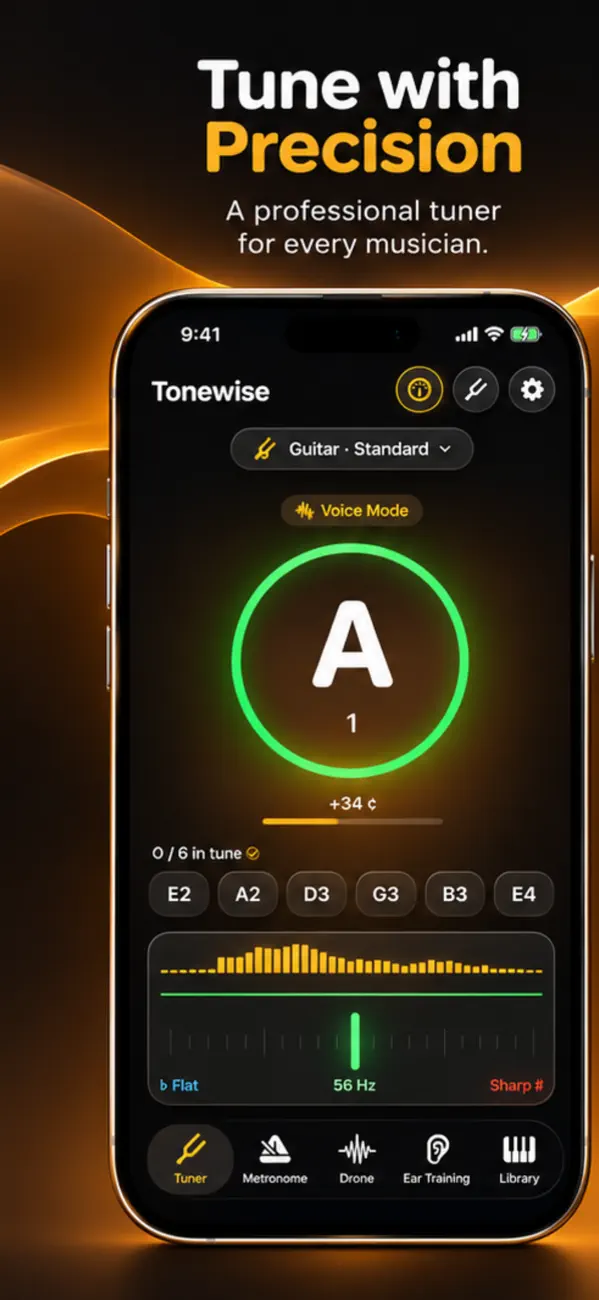


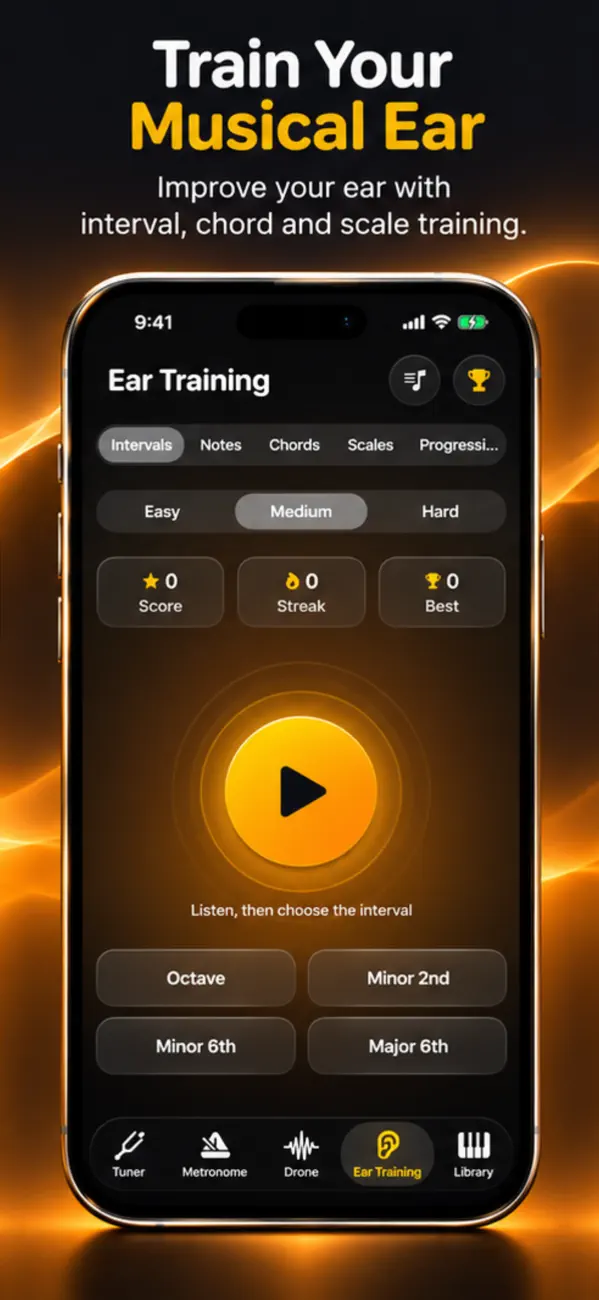

• Real-time chromatic tuning with cent-level accuracy
• Needle or strobe display, plus a live spectrum analyzer
• String-by-string guidance and a cent-history graph
• Adjustable reference pitch (415–466 Hz)
• Temperaments: Equal, Just and Pythagorean
• Mic sensitivity control and reference tones
• Voice Mode for singers and a spectrogram sound analyzer
Play a chord and Tonewise names it in real time, showing the exact notes it hears — a powerful way to learn songs by ear.
Tuning is more interesting than it looks. Cents, temperament and reference pitch explain why a perfectly tuned instrument can still sound wrong.
A4 = 440 Hz is the international reference pitch — the frequency everything else is measured against. Some orchestras tune slightly higher (442–443 Hz) for brightness.
432 Hz circulates online with claims about natural resonance and healing. There is no scientific support for those claims. If you enjoy how it sounds, that is a legitimate reason; the physics one is not.
A hundredth of a semitone — the unit tuners use because it is proportional. An octave is 1200 cents regardless of register, so the same cent value means the same perceived error high or low.
Trained listeners detect around 5–10 cents on sustained notes. Within ±5 cents is comfortably in tune for most instruments.
Mostly temperature and humidity — wood and steel expand at different rates, so a guitar taken from a cold car into a warm room will drift measurably. New strings also stretch for several days.
Mechanical causes: tuning down to a note rather than up leaves slack in the machine head, and a nut that pinches the string releases tension unevenly as you play.
Because tuners measure equal temperament, where every semitone is identical. That system is a compromise — it makes all keys usable at the cost of no interval being acoustically perfect.
On guitar this shows up as chords that beat slightly even when every string reads green. It is not your tuner being wrong; it is the tuning system being a deliberate trade-off.
Tonewise: Music Toolkit is a paid app priced at $7.99 on the App Store — a one-time purchase, not a subscription.
Tonewise: Music Toolkit runs on iPhone and iPad and requires iOS 18.0 or later.
The download size is 9 MB.
The current version is 1.0.8, released on 2026-11-15.
Tonewise: Music Toolkit is available in English, Arabic, Dutch, French, German, Hindi, Indonesian, Italian and more.
Tonewise: Music Toolkit is built by BIR (Build Intelligent Reality), an independent software studio founded by Birkan Aksoy. BIR has 38 apps on the App Store.
Straight answers — no app required.
All questions →


