
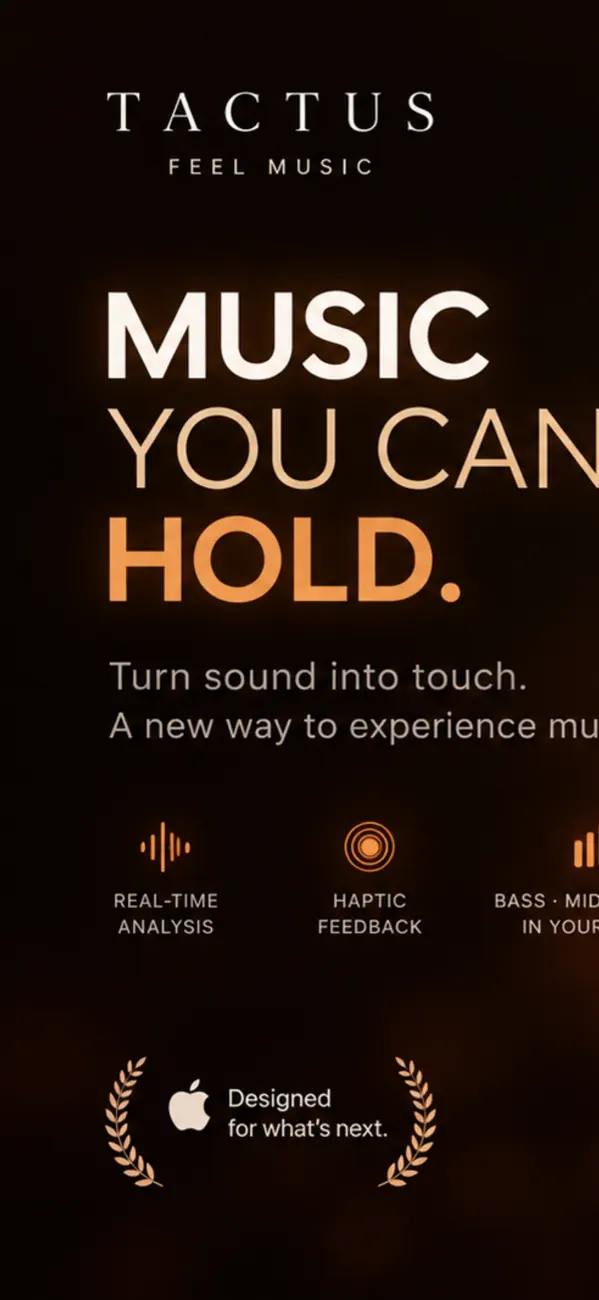
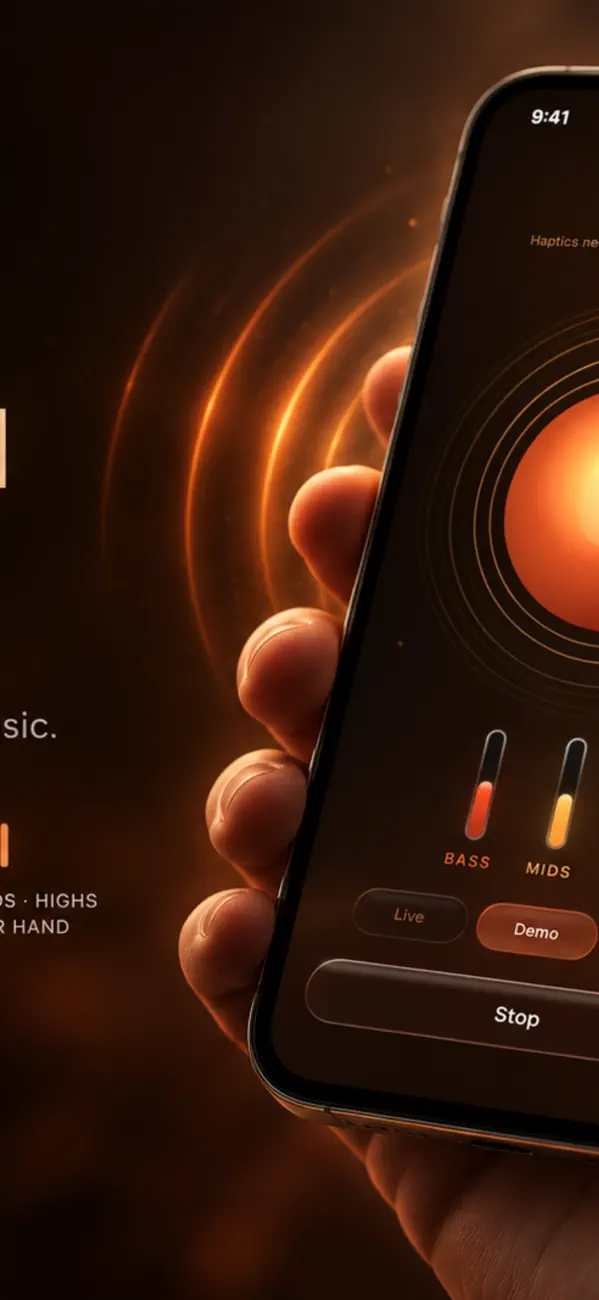
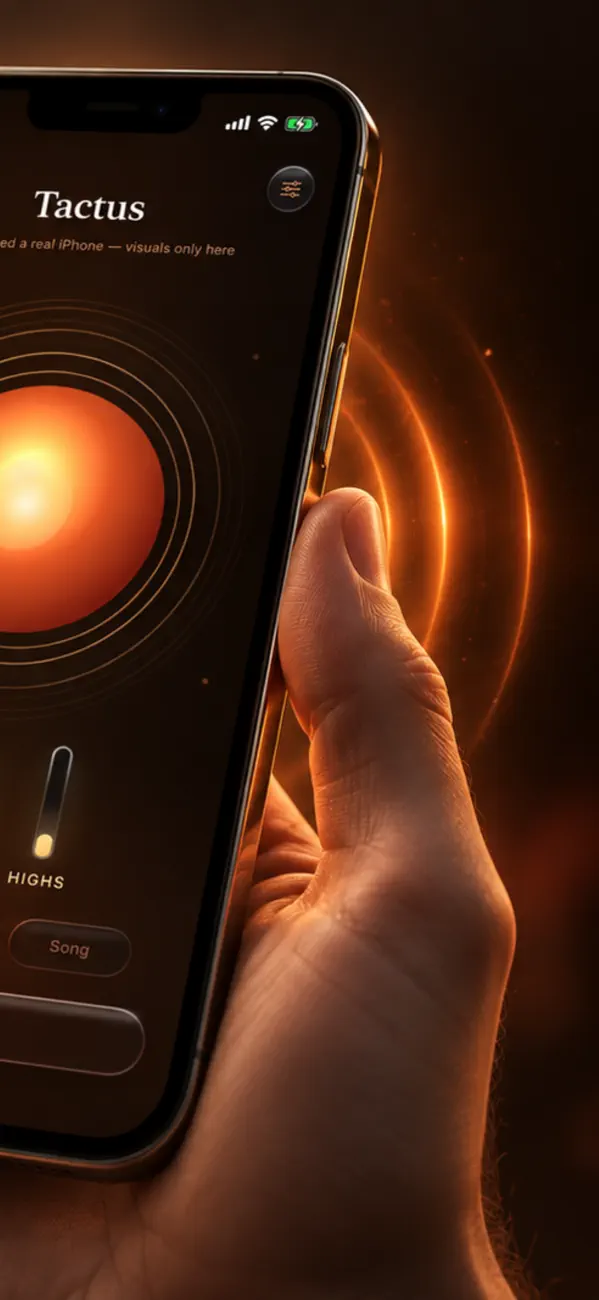

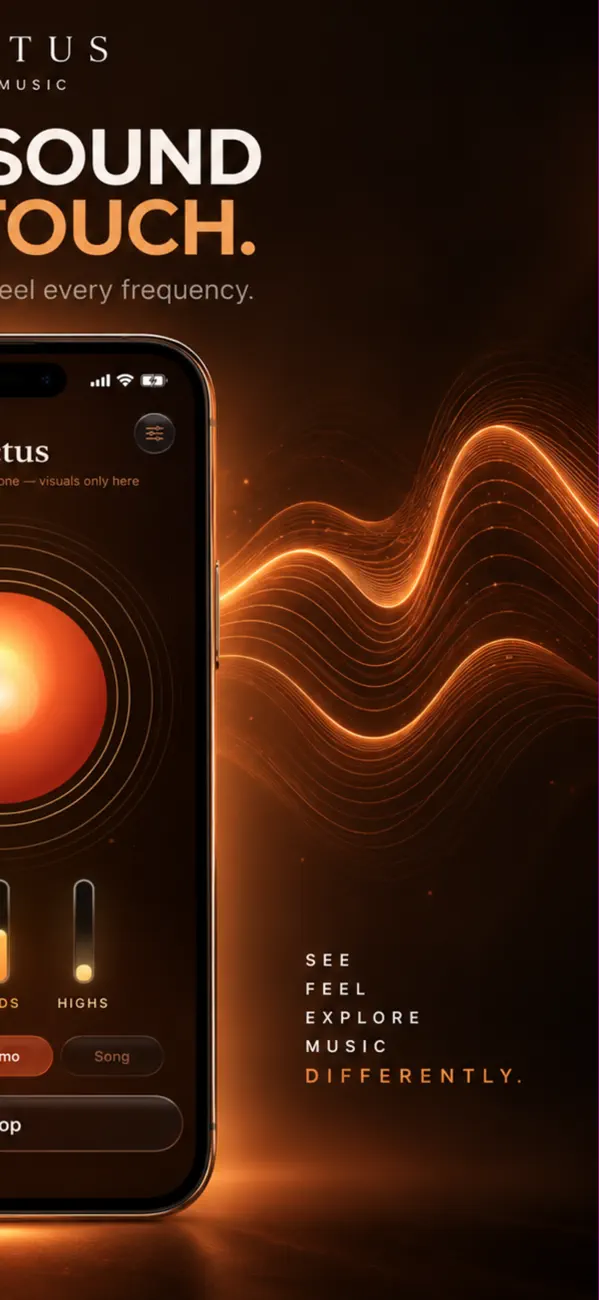
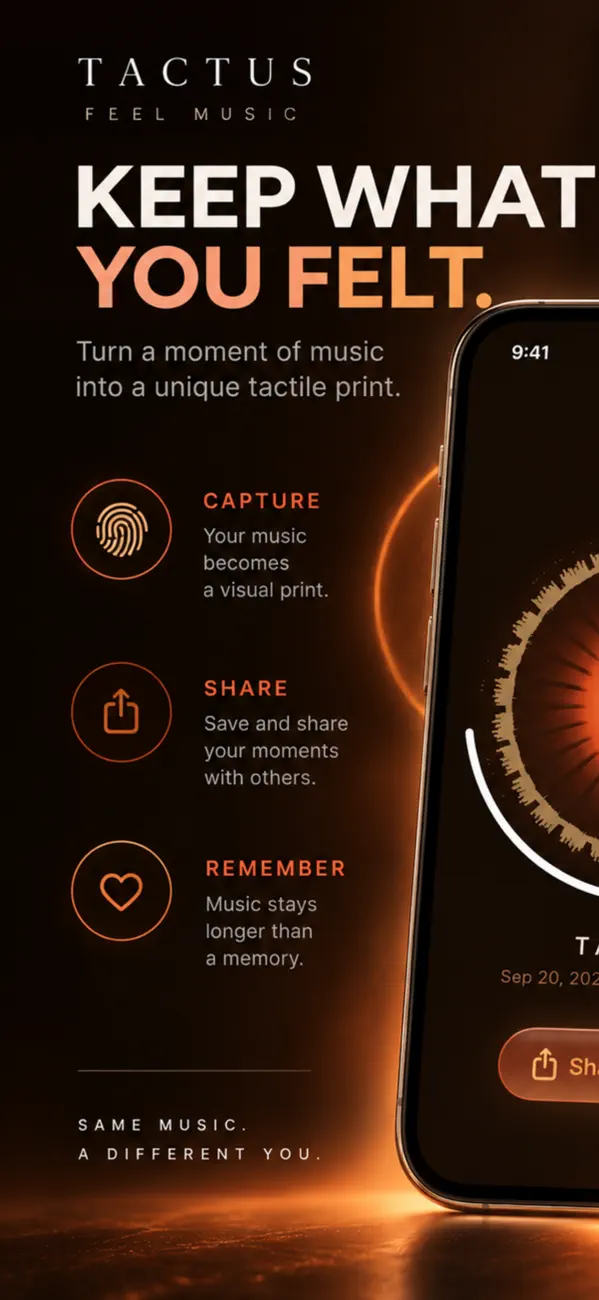
Tactus turns the music around you into rich, layered touch — bass as a deep swell in your palm, every beat a sharp tap, brightness as texture. Built with and for the deaf and hard-of-hearing community, and for anyone who wants to feel music in a new way.
Point the microphone at the world: concerts, weddings, rehearsals. Live captions transcribe vocals and announcements right under the visuals — entirely on your device.
Rest the phone on your open palm. Tilt left to feel only the bass bones of a song; tilt right for the rhythm's skeleton. Touch the living matter on screen and slide from its heart (pure bass) to its rim (pure shimmer).
Every session leaves a tactile print: radial art unique to that song, ready to share — or touch it to feel the whole night again.
VoiceOver throughout, magic tap to start and stop, high contrast and calm motion modes, and feel profiles for concerts, home and sleep.
No account. No ads. No data collected — nothing ever leaves your phone.
Tactus is free.
Feeling music through touch is not a gimmick — it maps onto how hearing and touch actually overlap in the body.
Yes. Skin mechanoreceptors respond to vibration in roughly the 20–1000 Hz range, which overlaps substantially with musical frequencies. Deaf percussionists have long described perceiving music primarily through the body rather than the ears.
Anyone who has stood near a bass cabinet has experienced the same thing. The chest response to low frequencies is touch, not hearing.
It reinforces rhythm. Timing information delivered through touch arrives on a channel that is not competing with the melody for attention, which is why a synchronised pulse makes a beat feel more defined.
It also makes music partially accessible in situations where sound is not — silent environments, or hearing loss.
Because different receptors respond to different ranges. Pacinian corpuscles are most sensitive around 200–300 Hz, which is why mid-bass frequencies feel most physically present, while very high frequencies are barely felt at all.
Long wavelengths also travel through floors and furniture, which is why you feel the neighbour's bass and not their vocals.
Tactus: Feel Music is a paid app priced at $4.79 on the App Store — a one-time purchase, not a subscription.
Tactus: Feel Music runs on iPhone and iPad and requires iOS 26.0 or later.
The download size is 4 MB.
The current version is 1.1.1, released on 2026-09-20.
Tactus: Feel Music is available in Arabic, English, French, German, Hindi, Italian, Japanese, Korean and more.
Tactus: Feel Music is built by BIR (Build Intelligent Reality), an independent software studio founded by Birkan Aksoy. BIR has 38 apps on the App Store.
Straight answers — no app required.
All questions →


